
The difference and connection between AI Agent and Agentic AI
To be honest, I was quite confused when I first saw Agentic AI. This thing is so similar to AI Agent. Then, after looking up information and reading articles in the past two days, I found that this concept was proposed by a professor named Andrew Ng. The basic meaning is that Agentic AI is the future of artificial intelligence. A big problem with current artificial intelligence is that it does not have the ability to think independently and solve problems independently. Moreover, even the so-called AI Agent can only design agents with different functions according to different application scenarios, and cannot directly make artificial intelligence think and solve problems like a real human.
We all know that the current large model is based on the concept of bionics, through the neural network model, imitating the principle of human brain operation, and using mathematical models to achieve a pseudo-intelligence based on probability and multi-disciplinary research results. In other words, the current large model is not a real intelligent body, and it is still a long way from real artificial intelligence. But with current technology, it is still the most likely way to achieve artificial intelligence.
If we start from the fundamental purpose of artificial intelligence, the purpose of artificial intelligence is to use a technology or method to realize a system that truly has the ability to think independently and solve problems. And how to make artificial intelligence have human intelligence is the fundamental problem that artificial intelligence needs to solve.
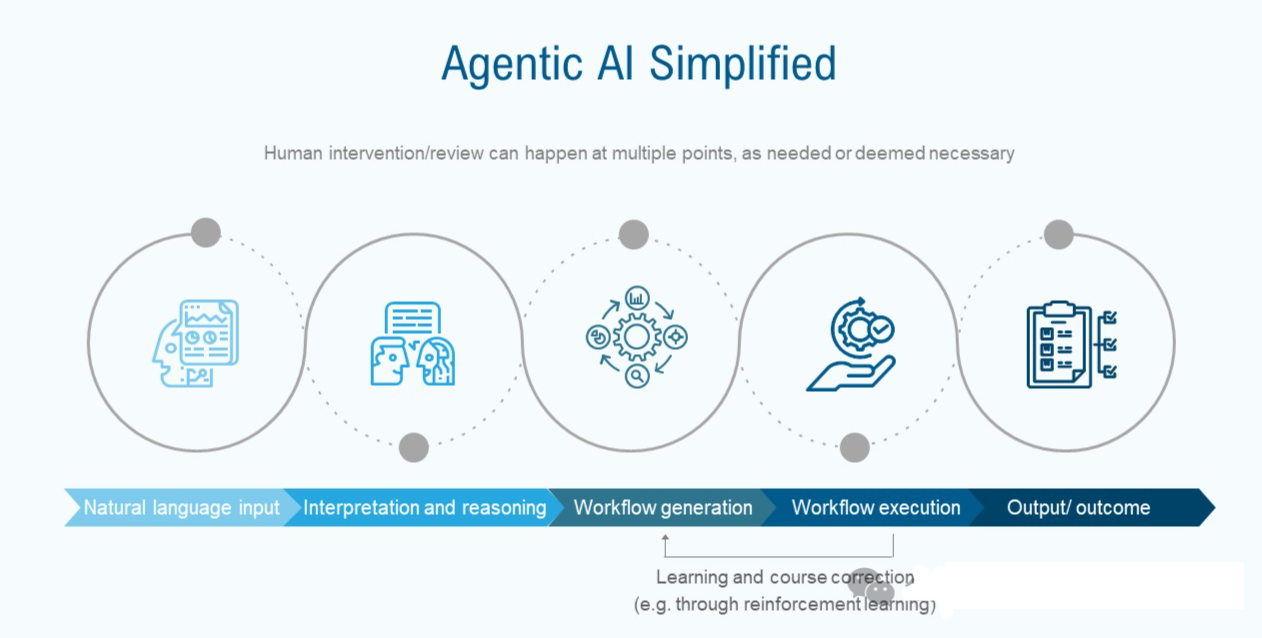
Agentic AI is a methodology or goal to achieve artificial intelligence with independent thinking and problem-solving capabilities.
Although Agentic AI is a new concept, it is more of a more advanced abstraction of AI Agent; that is, to make an Agent that solves a certain problem universal and to enable it to solve more problems.
The development of technology is a process of continuous exploration, especially in these emerging fields, it is a process of crossing the river by feeling the stones; the concept of Agentic AI may be proven to be correct in the future, or it may be proven to be wrong; but it is an idea and thinking of human beings to explore the realization of artificial intelligence.
So, let's answer this question now, what is Agentic AI?
Agentic AI is an exploration in the field of artificial intelligence, a vision of realizing true artificial intelligence, and also a concept; but the concept is just a concept after all, how to realize Agentic AI is still a problem that all practitioners interested in artificial intelligence need to consider.
AI Agent is currently a proven methodology that allows large models to have preliminary independent thinking capabilities, and there are already specific implementation methods, that is, specific landing scenarios.
Perhaps in the future, Agentic AI will be implemented in other ways, or it may be implemented through AI Agent.
Therefore, Agentic AI is a goal; and AI Agent is a specific implementation plan.
Core functions Agentic AI is more like a concept describing capabilities, emphasizing that AI systems can autonomously plan, make decisions, and perform tasks. Key features: Autonomy: Complete tasks without continuous intervention. Adaptability: Able to cope with complex environments and adjust behaviors. Goal-oriented: Actively achieve complex goals. AI Agent is a specific implementation of Agentic AI. It is an independent program entity that focuses on completing clear tasks. Key features: Task-driven: Focus on predefined tasks. Environmental interaction: Real-time interaction with users or systems. Modular design: Usually a smaller, separately deployed component.
Actual application scenarios Agentic AI general framework, suitable for complex systems: Autonomous driving system: handles global planning and real-time changing traffic conditions. Intelligent financial analysis: Dynamic analysis of market data and autonomous adjustment of investment strategies. Mars exploration robot: Autonomous exploration and decision-making under long-delay communication. AI Agent specific intelligent entity, usually single function: Chatbot: Answer user questions. Voice assistant: Process specific voice commands (such as querying the weather). Game AI: Interact as an opponent in the game.
Technical Implementation and Distinguishing Features Agentic AI AI Agent implementation difficulty requires complex algorithm design, including long-term memory, learning and reasoning capabilities. It is implemented in a smaller scope and can complete tasks using limited rules or strategies. Scenario complexity is applied to dynamic, multi-task and long-term environments. It is more suitable for specific, short-term and clear tasks. Core technologies usually include reinforcement learning, natural language processing, planning algorithms, etc. Use simple models or rules, which may include supervised learning or logical rules.
Relationship Agentic AI is a broader description of capabilities, and AI Agent is an entity that implements this capability. Agentic AI can drive multiple AI Agents to work. AI Agent is not necessarily Agentic AI: a simple chatbot can be an AI Agent, but it may not have the autonomy or adaptability of Agentic AI. Agentic AI can build AI Agent: a system with Agentic AI can generate multiple sub-agents to complete specific tasks.
Summary Agentic AI: It tends to describe the capabilities of artificial intelligence, focusing on its autonomy, adaptability and goal-oriented behavior. AI Agent: It is an application form of Agentic AI, manifested as an agent with specific functions. It can be understood that Agentic AI is an advanced capability, and AI Agent is the specific embodiment of using this capability to perform tasks.
AI-Powered Voice Agents: Revolutionizing Real-Time Appointment Booking for Healthcare Clinics

In today’s fast-paced healthcare industry, efficiency is key to both patient satisfaction and clinic success. As patient volumes grow and expectations rise, healthcare providers are turning to innovative technologies like AI-powered voice agents to streamline operations and improve customer experiences. One of the most transformative applications of this technology is real-time appointment booking.
Here’s a deep dive into how AI-powered voice agents are reshaping healthcare clinics and significantly cutting business costs.
What Are AI-Powered Voice Agents?
AI-powered voice agents are intelligent systems that can understand, interpret, and respond to human speech in real-time. These agents use advanced natural language processing (NLP) and machine learning algorithms to handle a wide range of tasks, including scheduling, rescheduling, and canceling appointments.
Unlike traditional automated systems that rely on rigid menus, AI voice agents engage in natural, conversational interactions, making them feel more like speaking to a human receptionist.
Benefits of AI-Powered Voice Agents for Healthcare Clinics
1. Seamless Real-Time Appointment Booking
AI voice agents enable patients to book appointments effortlessly, 24/7, without the need to wait for office hours or human availability. This immediate access improves patient satisfaction and ensures clinics don’t miss out on potential bookings.
- Example Use Case: A patient calls after hours to book an appointment. The AI agent confirms available slots, considers the patient’s preferences, and books the appointment in seconds.
2. Enhanced Patient Experience
AI agents provide a consistent and courteous experience, regardless of call volume or time of day. They can also handle multilingual communication, ensuring inclusivity and accessibility for diverse patient populations.
3. Reduction in Administrative Workload
Administrative staff often spend a significant amount of time managing phone calls and scheduling appointments. By automating these tasks, AI voice agents free up staff to focus on more critical, value-driven responsibilities, such as patient care and record management.
4. Minimized Errors in Scheduling
Human errors, such as double-booking or incorrect appointment entries, can lead to inefficiencies and patient dissatisfaction. AI agents ensure accuracy by cross-checking schedules and integrating seamlessly with clinic management systems.
How AI Voice Agents Help Cut Business Costs
1. Lower Labor Costs
With AI voice agents handling the bulk of appointment-related calls, clinics can reduce the need for additional front-desk staff, saving on labor costs while maintaining high service standards.
2. Reduced Call Wait Times
Patients no longer need to endure long wait times on hold, which improves retention and reduces the likelihood of losing potential patients to competitors.
3. Improved Operational Efficiency
AI systems optimize scheduling by identifying gaps in the calendar and filling them efficiently, maximizing the clinic’s capacity and revenue potential.
4. Scalability Without Added Costs
As a clinic grows, so does the volume of appointment requests. AI voice agents can scale effortlessly, handling increased demand without requiring significant infrastructure or additional personnel.
Real-World Impact: Transforming Clinics with AI
Let’s consider a mid-sized clinic that handles approximately 300 appointment-related calls per day. By implementing an AI-powered voice agent:
- Labor Cost Savings: Replacing or supplementing two full-time receptionists could save $60,000+ annually.
- Operational Efficiency: Reducing scheduling errors could reclaim 15-20 hours of staff time each month.
- Revenue Growth: Filling cancellations and optimizing schedules could increase monthly revenue by 10-15%.
Future Prospects
AI-powered voice agents are just the beginning. Future integrations with telemedicine platforms, patient records, and predictive analytics could further enhance their functionality. Clinics that embrace these technologies will not only reduce costs but also position themselves as leaders in delivering modern, patient-centric care.
Conclusion
AI-powered voice agents are transforming healthcare clinics by making real-time appointment booking seamless, improving patient satisfaction, and cutting operational costs. By adopting this technology, clinics can provide a superior experience to patients while optimizing their resources and boosting profitability.
Now is the time to invest in AI-powered solutions and future-proof your healthcare business. Embrace the change, and watch your clinic thrive in an increasingly competitive industry.
Ready to transform your clinic’s operations? Let technology work for you!